Where the Water Begins
A Fable for Late Bloomers


The story
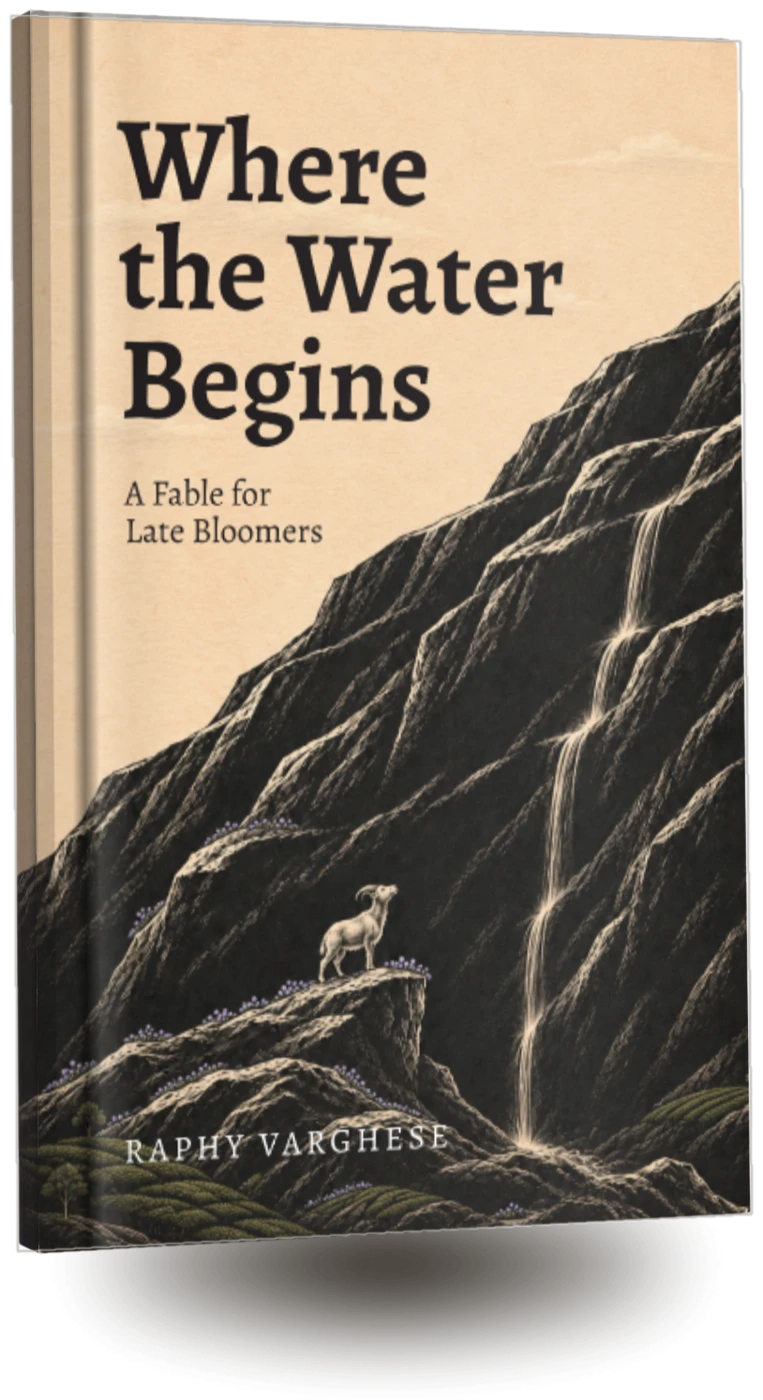
Neel is the smallest in his herd and the slowest to climb. He lives in the Nilgiri hills of South India, beside a shelter tree and a stream, and he is the only one who ever asks where that stream begins.
Every year the herd climbs the First Ridge. Every year Neel turns back. Slowly he starts to believe what the herd believes: some animals are built for the hill, and he is not one of them.
Then he meets a climber the herd calls a fool, who has been practising alone at the far rocks for years. She does not cheer him on. She shows him where to put his feet.
The climb takes far longer than he expects. There is a night he is not sure he will survive. And what he finds at the top is both smaller and larger than he imagined.
He was the smallest in the herd, and the slowest to climb.
Who it's for.
Students and graduates
Anyone who has been compared, ranked or told they are behind.
People who failed and tried again
For the ones who failed the same thing more than once and are still climbing.
A gift that takes an hour
Short enough to read in one sitting, and it stays on the shelf.
Read it? Say so.
Reviews are how a small book finds its next reader. Two honest lines on Amazon do more than any advert.
Before you buy.
Who is this book for?
Older children, teenagers and adults. It is written as a fable, so a twelve-year-old can follow it and an adult will recognise themselves in it.
How long does it take to read?
About one hour. It has nine short chapters, each with a scratchboard-style illustration.
Can I read it free?
Yes, if you have Kindle Unlimited. Otherwise the Kindle edition is ₹99, the paperback ₹185 and the hardcover ₹295.
Where is the story set?
In the Nilgiri hills of South India, among the tea terraces and the Neelakurinji, the flower that blooms once every twelve years.